
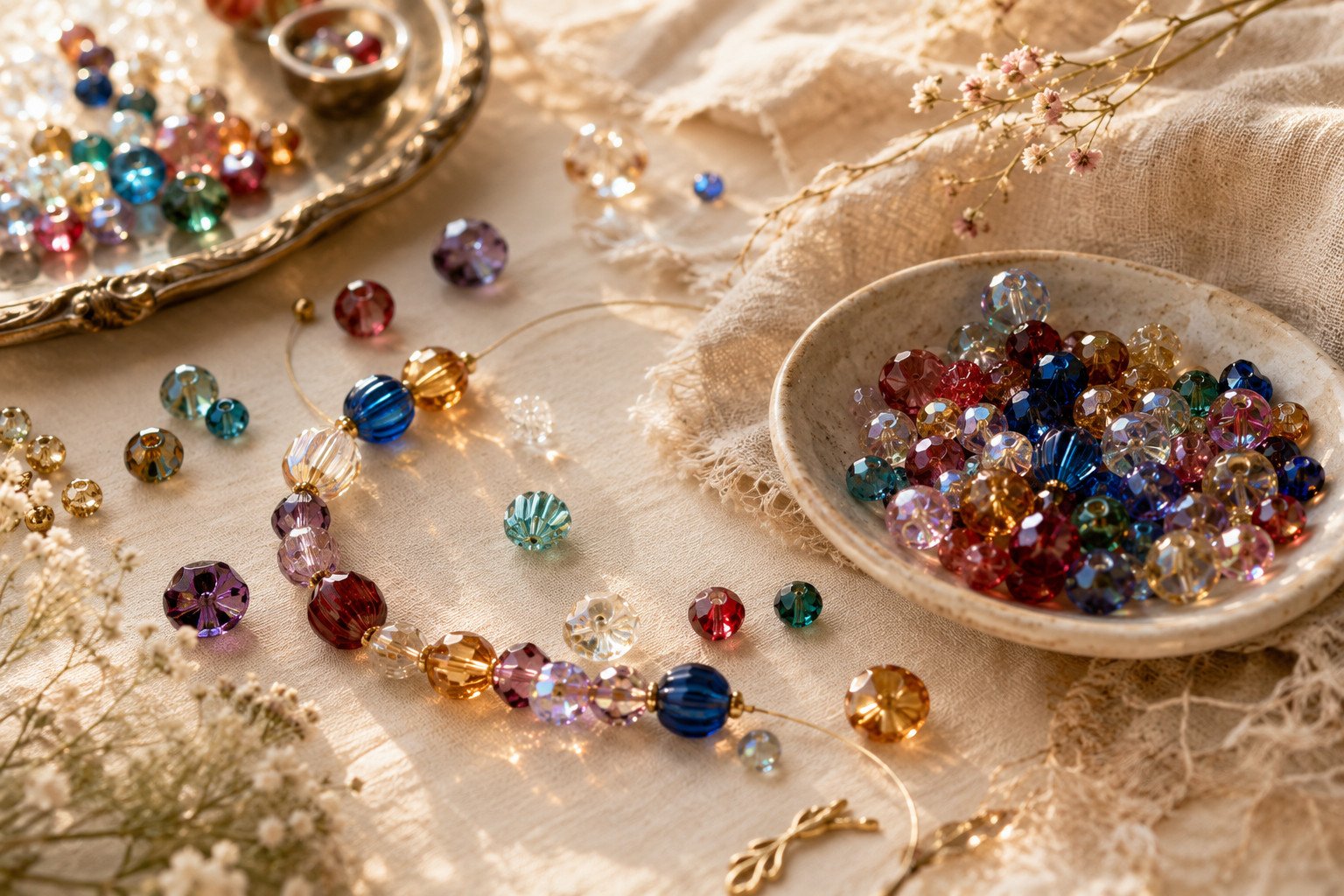
« Bohemian glass is an intricate art form that stays true to its roots. »
— Maxim Velčovský, Art Director at Lasvit
✧
Before becoming part of a bracelet, necklace, embroidery or a sparkling detail on an accessory, a glass bead already carries a long history.
Czech glass beads, historically also known as Bohemian glass beads, are one of those small objects we think we know because we have seen them in craft boxes, vintage jewelry or colorful creations. Yet behind their sparkle lies a whole world — a region, workshops, glassmakers, skilled techniques, carefully developed colors and a long tradition rooted in glassmaking.
They are not merely decorative. They tell the story of a meeting between material and light, craftsmanship and industry, European history and contemporary creativity.
So where do these beads really come from? How are they made? And what makes them so distinctive that they continue to inspire lovers of jewelry, embroidery and fine materials today?
A region shaped by glass — Bohemia, Crystal Valley and Jablonec nad Nisou
Bohemia
To understand Czech beads, we first need to look to Bohemia. This historic region of Central Europe makes up a large part of what is now the Czech Republic. For centuries, it has been closely associated with glassmaking, crystal, jewelry, beads and decorative ornaments.
Crystal Valley
In northern Bohemia, this glassmaking tradition is especially strong in an area now promoted under the name Crystal Valley. It is not an administrative region in the strict sense, but rather a cultural and craft territory bringing together towns, workshops, museums, schools and companies connected with glassmaking and jewelry. The official Crystal Valley website presents it as a unique glassmaking region with more than 700 years of tradition.
Crystal Valley encompasses several areas of northern Bohemia, including the Jizera Mountains, the Giant Mountains, the Lusatian Mountains, the Bohemian Paradise and other areas associated with glass, crystal, jewelry, lighting, ornaments and decorative objects.
Before the glassmaker’s skill even comes into play, there are the raw materials of the landscape — silica-rich sands, essential for making glass, along with water, forests and mountains, followed by the fire of the workshops. It was from this meeting between natural resources and human craftsmanship that part of Bohemia’s glassmaking tradition was born.
Jablonec nad Nisou
Within this wider region, Jablonec nad Nisou holds a particularly important place. Even today, the town retains a strong identity centered on glassmaking and jewelry, with a history closely linked to costume jewelry, glass beads, buttons, ornaments and the glass trade.
It is also home to the Museum of Glass and jewelry, whose collections highlight the importance of this local tradition.
What makes this region so distinctive is that its tradition does not rest on a single workshop or one particular glassmaking house. It developed through an entire network of crafts and professions — glassmakers, blowers, cutters, polishers, bead makers, jewelry makers, designers and merchants. Today, Crystal Valley highlights this diversity through glassworks, jewelry manufacturers, museums, workshops, schools and places dedicated to preserving the memory and heritage of glassmaking.
Bohemian beads are therefore far more than small glass beads. They belong to a region where glass has become a true part of its identity — shaped, passed down, exported and admired, yet also deeply connected to the landscape, to skilled hands and to a living craft heritage.
Bohemian beads, Czech beads, Bohemian glass, Bohemian crystal and Preciosa crystal — understanding the terminology
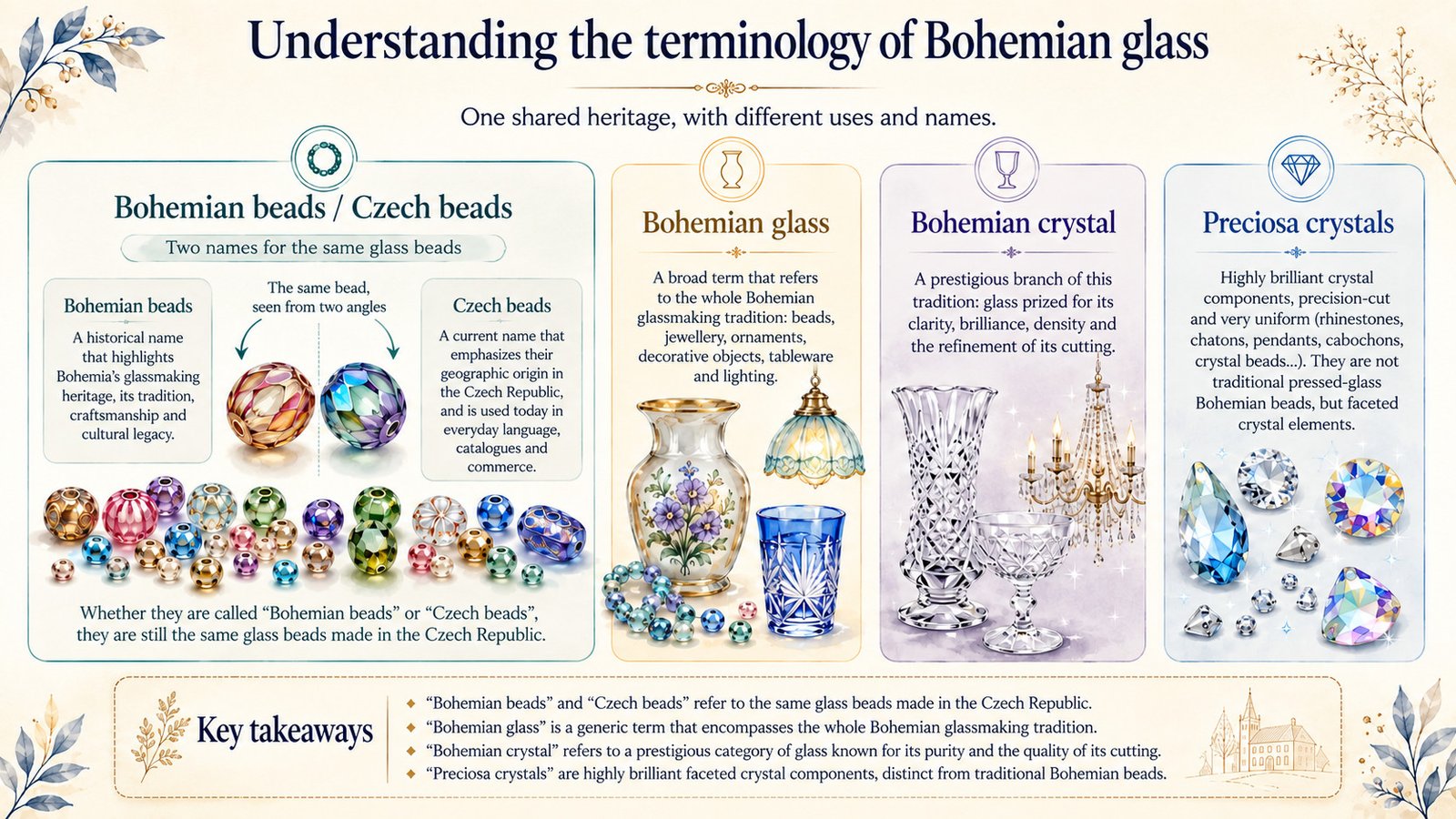
The terms “Bohemian beads”, “Czech beads”, “Bohemian glass” and “Bohemian crystal” are sometimes used together, which can be confusing. They all belong to the same broad glassmaking tradition, but they do not mean exactly the same thing.
“Bohemian beads” and “Czech beads”
These two terms refer to the same type of glass beads, but they place the emphasis on slightly different things.
“Bohemian beads” is the more historical and evocative term, with an almost poetic feel. It refers to the region of Bohemia, its heritage and Jablonec nad Nisou. The name carries associations with tradition, the prestige of Bohemian glass, historic workshops, colorful jewelry, delicate ornaments and the idea of craftsmanship passed down through generations.
“Czech beads” is a more modern and geographical term — it places these beads within today’s Czech Republic. It also appears in product ranges and brand names, such as PRECIOSA Traditional Czech Beads™. The term highlights their Czech origin and the continuity of this long-standing expertise.
Bohemian glass
Bohemian glass is a broad term referring to the entire glassmaking tradition associated with Bohemia. It includes blown glass, decorated glassware, beads, jewelry, ornaments, cut glass, lighting, tableware and works of art. It represents the wider glassmaking heritage of the region.
Bohemian crystal
Bohemian crystal, on the other hand, represents a more specific and prestigious branch of this glassmaking tradition. It is still glass, but its composition and craftsmanship are designed to enhance brilliance, density and the precision of the cut. Historically, Bohemian crystal became renowned for clear, finely cut, engraved or polished pieces that catch and reflect the light, producing the distinctive ringing tone often associated with fine-quality glassware. Today, the term mainly evokes glasses, vases, chandeliers, bowls and decorative objects rooted in the Czech glassmaking tradition.
Preciosa crystal
In craft and jewelry-making shops, you may come across terms such as “Preciosa crystal”, “Preciosa crystals” or “Preciosa crystal beads”. These are highly brilliant, faceted components belonging to specific Preciosa ranges, including rhinestones, chatons, fancy stones, pendants and crystal beads. Their transparency, gemstone-like sparkle and the precision and regularity of their facets help explain their popularity.
These elements certainly belong to the wider world of Bohemian glass and crystal, but they do not refer to all Bohemian glass beads.
Bohemian beads are primarily pierced components that can be strung, sewn, embroidered or incorporated into jewelry and decorative pieces.
Pressed beads, for example, are generally made from a heated glass rod that is pressed into a mold, then tumbled, sorted and sometimes faceted, fire-polished or given a surface finish.
Preciosa crystals, by contrast, are more closely associated with precision machine-cut crystal components. Some may be drilled, such as beads or pendants, while others are not, including rhinestones, chatons and fancy stones designed to be set, glued or sewn into place.
Preciosa Components and Preciosa Ornela
This distinction is important because the Preciosa name covers several different areas. Preciosa Components specializes in cut crystal components used in fashion, jewelry, embellishment and certain high-end creations. Preciosa Ornela is associated with glass rods, seed beads, pressed beads, fire-polished beads and other Czech glass products.
So, whether we are talking about Preciosa crystals, Bohemian beads or Bohemian crystal, they all belong to the wider Czech glassmaking tradition. However, they do not always refer to the same objects, the same uses or the same manufacturing processes.
Bohemia
The word Bohemia itself carries a particular resonance. It evokes not only a region, but also a craft tradition, colorful jewelry, well-traveled objects and luminous materials.
Glass beads
Finally, “glass beads” is a general term. Not all glass beads are Bohemian or Czech beads. Glass beads are made in many countries, with very different levels of quality depending on the workshops, materials and manufacturing processes used.
When UNESCO recognizes the art of glassmaking
Traditional glassmaking skills inscribed by UNESCO in 2023
In 2023, UNESCO inscribed the knowledge, techniques and skills of traditional glassmaking on the Representative List of the Intangible Cultural Heritage of Humanity. This recognition is not specific to the Czech Republic alone. Finland, France, Germany, Hungary, Spain and the Czech Republic submitted the nomination jointly. It recognizes shared glassmaking practices — shaping, blowing, decorating and working glass both hot and cold — in workshops where transmission of knowledge, teamwork and mastery of fire play an essential role.
This 2023 inscription therefore places the Czech Republic within a broader European glassmaking tradition. UNESCO did not inscribe “Bohemian beads” as such, but it did recognize the importance of the skills, crafts and transmission associated with traditional glassmaking — a heritage of which the Czech Republic is very much a part.
Glass bead Christmas decorations inscribed by UNESCO in 2020
Another UNESCO inscription relates more directly to beads, although in a very specific context. In 2020, UNESCO inscribed the traditional craft of making Christmas tree decorations from blown glass beads in the Czech Republic. This tradition forms an important part of the cultural heritage of the Giant Mountains and Jizera Mountains regions in northern Bohemia. Craftspeople in these areas have been making blown glass beads since the late 18th century.
These inscriptions do not tell the whole story of Bohemian beads, but they do confirm the importance of the Czech glassmaking tradition. They show that, in northern Bohemia, glass is far more than a decorative material. It is a living heritage shaped by skill, transmission, patience and light.
Who makes Bohemian glass beads?
Bohemian beads are sometimes imagined as being shaped one by one by a lone craftsperson working in a small workshop. In reality, the picture is more nuanced — and perhaps even more interesting.
Bohemian glass beads can come from several different types of producers. They may be made in specialist workshops, family-run businesses, manufacturing companies or larger industrial facilities.
Behind these beads lies the work of several different crafts.
Glassmakers, who understand the material, temperatures, colors, mixtures, glass rods, and the effects of transparency and opacity.
Bead makers, who transform the glass into usable shapes — round beads, faceted beads, pressed beads, seed beads, fire-polished beads, drops, flowers, leaves and other decorative shapes
There are also people involved in the cutting, polishing, finishing, sorting, quality control, stringing and packaging stages. Machines assist with some parts of the process, but at other stages an experienced eye, a precise hand and a detailed understanding of both flaws and quality remain essential.
It is therefore best not to describe all Bohemian beads as strictly “handmade”. Some are produced using artisanal or semi-artisanal methods, while others are made industrially. What they all share, however, is a glassmaking heritage, specialized expertise and a long technical tradition.
That very combination is what makes the subject so fascinating. Bohemian beads sit at the crossroads of tradition and organized production, of age-old techniques and modern precision. They show that even serial production can still carry the mark of genuine craftsmanship.
From glass rods to Czech beads — a traditional craft
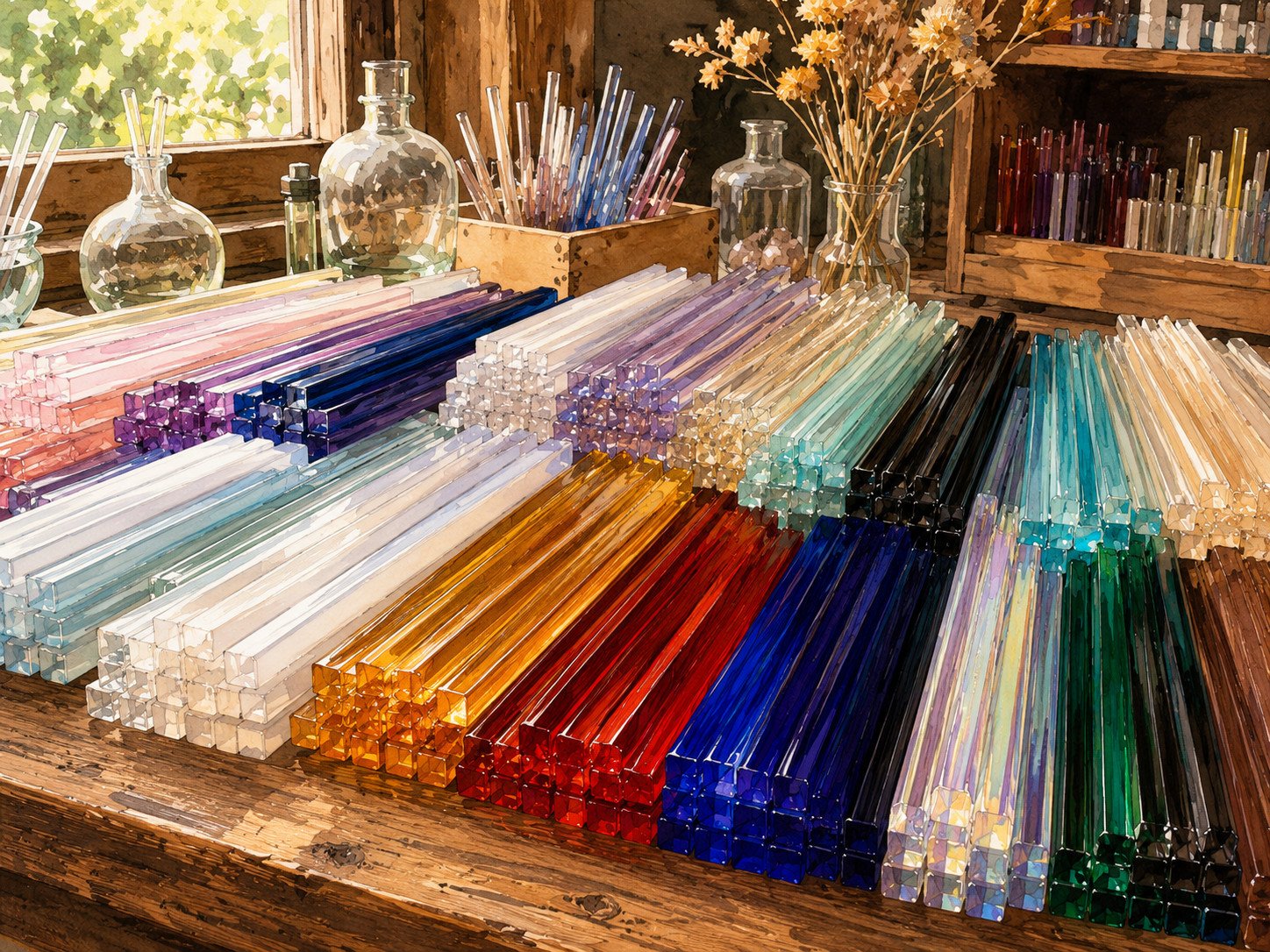
Colored glass rods
The traditional production of Bohemian glass beads begins with long rods or canes of glass that are already colored throughout. This color forms the base of the future bead. The rods may be made from transparent, opal or opaque glass, with alabaster-like finishes, or in shades such as blue, red, green, amber, black and white. They can also be more or less translucent, with silky or milky effects. Once the glass is heated and pressed into a mold, the bead retains this base color. Surface finishes are then added to create reflections and decorative effects.
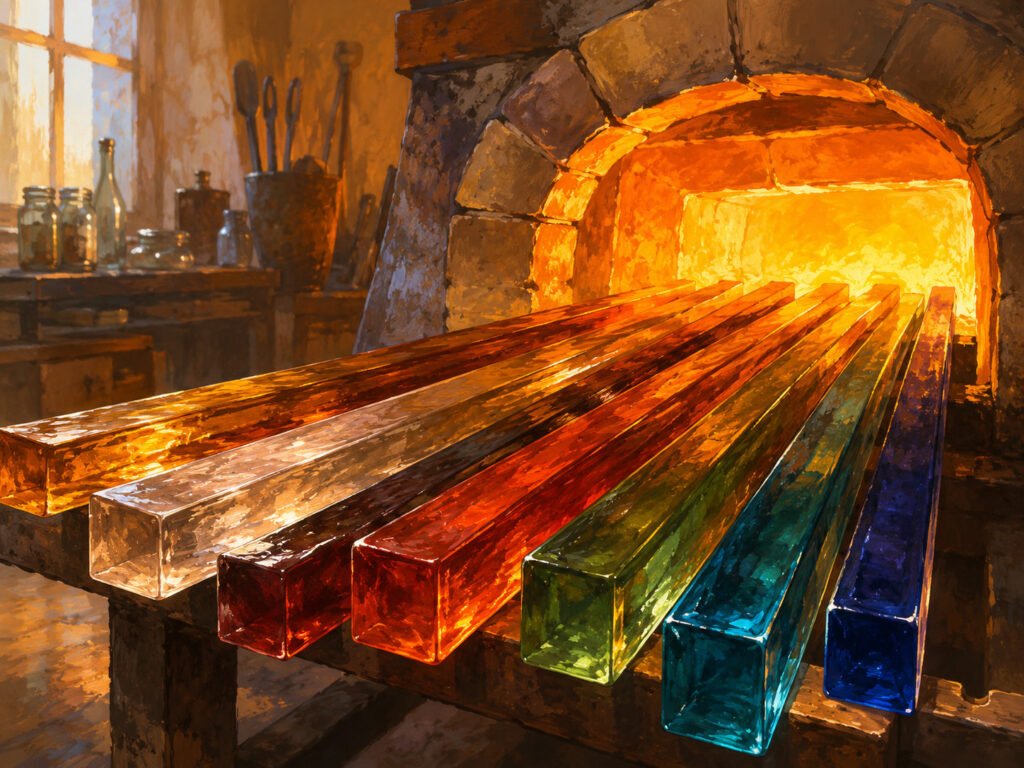
Heating the glass — making the material malleable
Before it can become a bead, the glass first has to be heated to a high temperature. The process begins with colored glass rods or canes, selected according to the desired color, transparency and appearance. Under the heat, the end of the rod becomes glowing, soft and malleable. Glassmakers can then shape the material, control the amount of glass used and press it into form.
Depending on the workshop and the production method, this stage may be more or less visible.
In a workshop-based approach, the craftsperson heats the end of the glass rod by hand. They watch the material closely, rotate it and guide it toward the press at the right moment. Heating and pressing then appear as two successive steps — first making the glass malleable, then placing it into the mold.
In a fully mechanized production process, the long glass rods enter the machine directly. The machine gradually heats the glass, measures out the required amount and feeds it into the pressing system. The human touch is less visible at this stage, but the principle remains the same — a hard, cold material is transformed into hot, pliable glass, ready to take the shape of a bead.
Pressing — when the bead takes shape in the mold
Once the glass is hot enough, it moves on to the pressing stage. In a workshop-based approach, the craftsperson guides the softened glass into a press or small mold that gives it its shape. In a more mechanized production process, the same machine heats the glass rods, measures out the softened material and then presses it into the molds. In both cases, the hot glass enters a mold that forms the shape of the bead.
This is the stage at which the different shapes are formed — round, oval, floral, teardrop, leaf-shaped, heart-shaped, geometric or decorative. During pressing, a fine metal rod or needle passes through the softened glass to create the bead hole. It is not drilled afterwards — the bead already emerges with its central hole in place.
As they leave the press, however, the beads do not yet have their finished appearance. At first, they form a continuous row, rather like a small chain of beads still connected by thin excess pieces of glass. This glass around the beads is fragile. Some parts already break away naturally when the row falls into the container after pressing. The beads begin to separate, but they still retain rough edges or small traces of excess glass around their shape. To make them more even and smoother to the touch, they then move on to the tumbling stage.
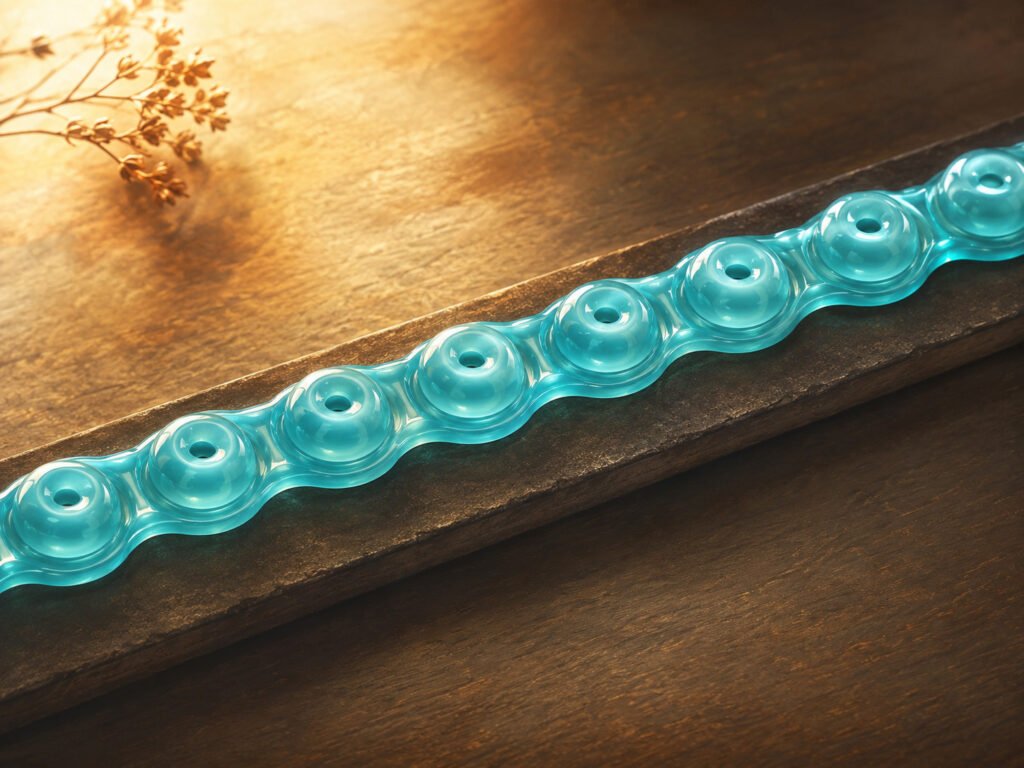
Tumbling — a stage that varies between workshops
As they leave the press, the beads are still arranged in rows connected by excess glass. Although the mold has already given them their general shape, they may still have fine burrs, sharp edges or small traces left by the pressing process.
To separate them and make their shape more even, the beads then go through a tumbling stage.
Tumbling is not always carried out in exactly the same way. Depending on the workshop, the type of bead, the quantity being produced and the desired finish, the beads may go through one or several tumbling phases.
Dry tumbling — breaking away excess glass
In some cases, an initial dry tumbling stage is used to break away the most fragile excess glass. Still bearing marks from the pressing process, the beads are placed in a rotating drum or container, where they tumble for a period of time with materials that create friction. This repeated movement helps make their outlines more even, detach the fragile pieces of glass still linking them together and soften the seams left by the mold.
Depending on the workshop, different accompanying materials may be used during this tumbling stage. These can include small pieces of cork, wood, rubber or other gently abrasive materials that help rub the beads without damaging them. At this point, the aim is not yet to give them their final shine, but to remove burrs, clean them and make them smoother and more pleasant to the touch.
Water tumbling — smoothing the beads after pressing
The beads may then go through a water tumbling stage, using a fine abrasive such as very fine sand. This step works more as a smoothing and cleaning process. The water supports the movement, carries away some of the residue and gradually helps soften the surface of the beads. It can be seen as a gentler stage that refines their finish.
In larger or more mechanized workshops, these operations may sometimes be combined and carried out automatically by machines. The underlying principle remains the same — separating, deburring, smoothing and preparing the beads for the next stages. What changes most is the scale of production, the length of each cycle, the materials used and the level of human involvement.
There is no single way to tumble beads. Each workshop adapts this stage to its own machines, methods and the result it wants to achieve.
After tumbling, the beads go through washing, sorting and quality control. If they are not faceted or given any special coating, they can then be considered finished beads. These are pressed beads, one of the main families of Bohemian glass beads.
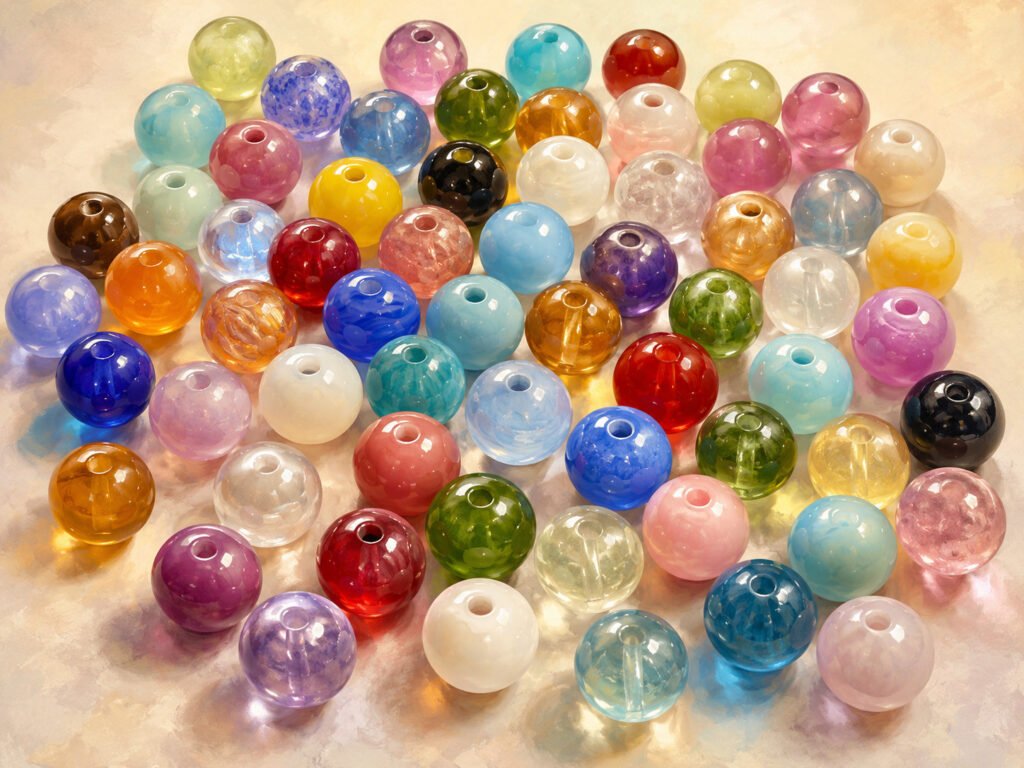
Faceting — bringing out flashes of light
After pressing and tumbling, some beads undergo a further stage of transformation. To give them more texture and sparkle, they may be faceted. Faceting involves creating small flat surfaces on the bead, like tiny windows that catch and reflect the light.
The bead used for this stage has already been pressed. The starting bead may be round, but faceting can also be applied to a wide variety of shapes. In the workshop, the beads are arranged on a support and brought into contact with a grinding wheel or abrasive disc. This process removes a very fine layer of glass and creates the facets. Depending on the type of workshop or machine, the beads may be placed on a tray, mounted on rods or strung before passing in front of the grinding wheel. The principle remains the same — the glass is ground with precision to produce regular, polished surfaces that reflect the light.
Immediately after this mechanical cutting stage, the bead has not yet reached its final brilliance. After grinding, the facets may look slightly dull, whitish, rough or a little cloudy — abrasion leaves visible marks on the glass. This is precisely why an additional step is needed: fire polishing.
Fire polishing — softening the facets and restoring the shine
After faceting, the beads are heated again to create fire-polished beads. The temperature softens the surface of the glass ever so slightly — just enough to smooth the edges and restore the shine without distorting the bead. This heat softens the tiny ridges, revives the brilliance and gives the facets a smoother, more luminous appearance.
This stage is what gives fire-polished beads their distinctive charm. They retain the sparkle of the facets, but with softened edges.
During production, the beads may be placed on trays or carried on a conveyor belt toward the kiln. Supports or separating powders can also be used to prevent them from sticking together under the heat. The aim is not to melt the bead again, but simply to smooth its surface. It is this final passage through the heat that gives them their name: fire-polished beads.
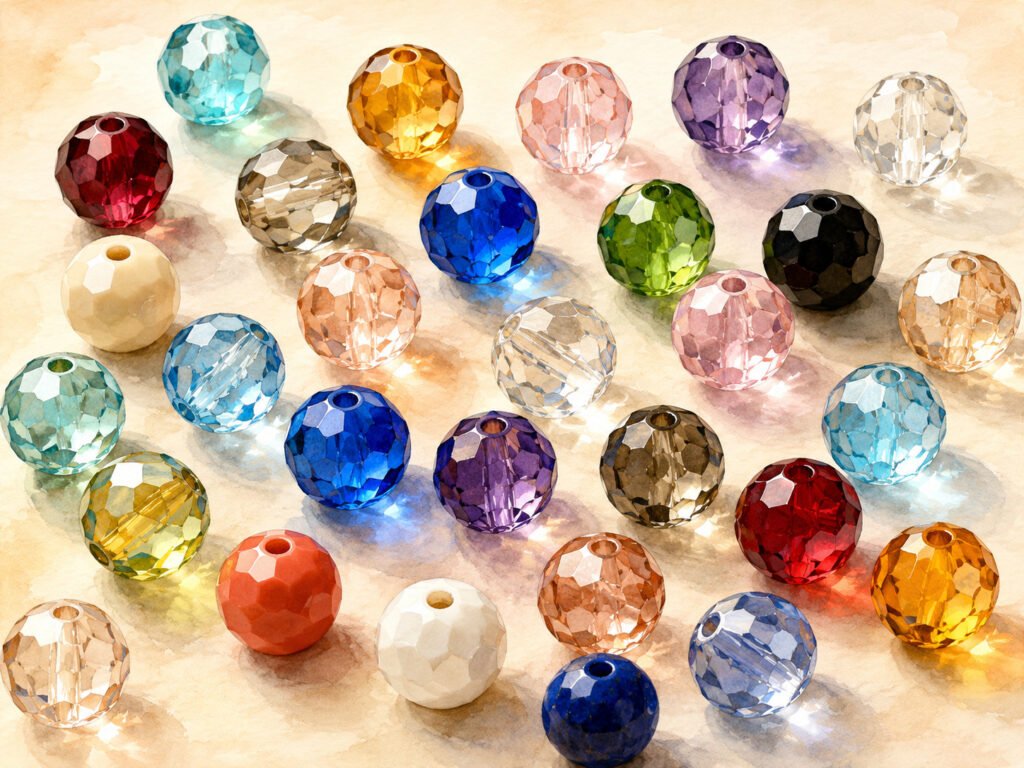
Table cutting — creating flat, decorative surfaces
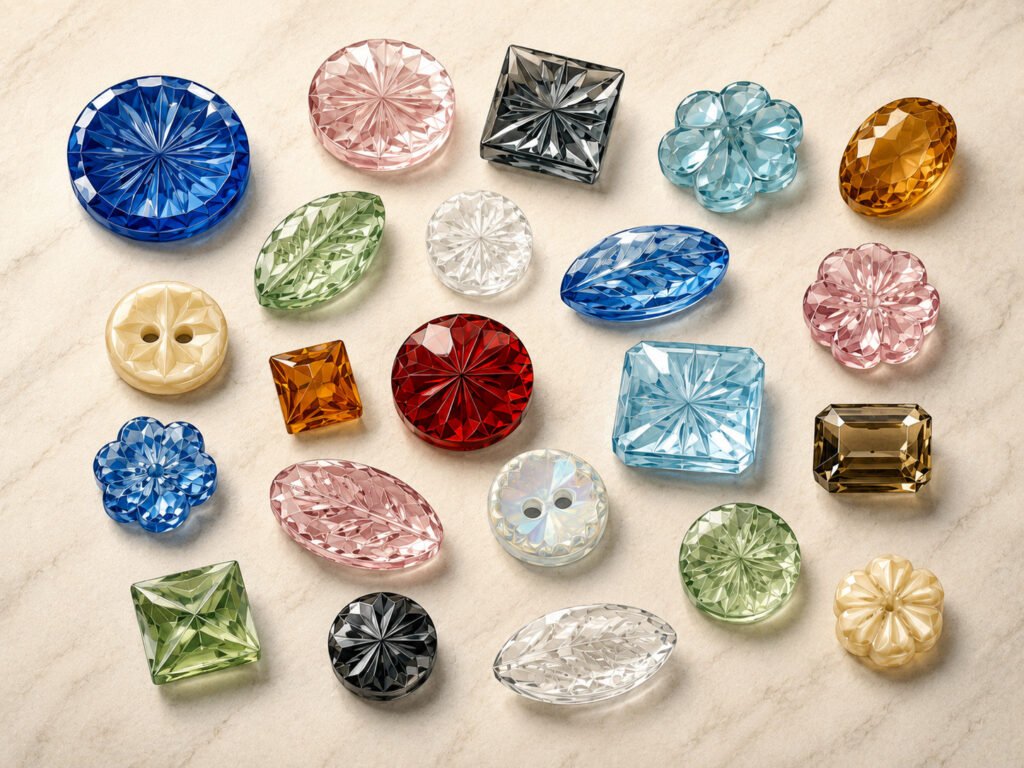
Table cutting is another form of glassworking carried out after pressing. It also involves grinding the bead, but the desired result is different. Instead of creating small facets all around the bead, one or more areas are often flattened or cut away to form distinct flat surfaces. The bead then takes on a more graphic appearance, with smooth planes contrasting with the parts that remain rounded or molded.
This technique is widely used for certain flat beads, discs, ovals, rectangles, flowers and other decorative shapes. It can also be applied to pieces similar to buttons, sometimes with two holes, designed to be sewn on or used as ornamental elements. Table cutting is especially effective for highlighting contrasts — for example, a dark opaque glass coated with a metallic finish, then ground at the surface to reveal the color of the glass underneath.
The effects can therefore be distinguished in this way: faceting creates multiple small flashes of light around the bead, while table cutting produces broader, more defined surfaces that are often decorative. Both techniques involve grinding, but they create very different styles — fire polishing may follow faceting, whereas table cutting does not necessarily require it.
Czech seed beads — tiny beads for embroidery, weaving and creative work
Alongside pressed beads, fire-polished beads and table-cut beads, Czech seed beads should not be overlooked. These tiny glass beads, often slightly irregular in shape, hold an important place in the world of Bohemian beads. They are used in bead embroidery, bead weaving and fine jewelry, as well as to create delicate patterns, fringes, bracelets, necklaces, textile embellishments and decorative accessories.
Unlike pressed beads, seed beads are not formed one by one in a mold. They begin as very fine hollow glass tubes, rather like tiny straws. These tubes are cut into small sections, then the pieces are reheated and tumbled in a rotating machine. Under the combined effect of heat and movement, the cut edges gradually become rounded. The small pieces of glass are transformed into more regular seed beads, already pierced thanks to the hollow center of the original tube.
Their tiny size requires a high degree of regularity, as they need to line up neatly in bead weaving or embroidery. This precision is what makes them so valuable to makers. A single seed bead may seem discreet on its own, but repeated by the hundreds or thousands, it becomes pattern, texture, light and movement.
Seed beads can be transparent, opaque, iridescent, pearlescent, metallic, matte, colored throughout or enhanced with surface finishes. They reveal another side of Czech glassmaking expertise — no longer the bead as a small sculpted object, but the bead as a point of light, used to create patterns, flexible jewelry and intricate decorative work.
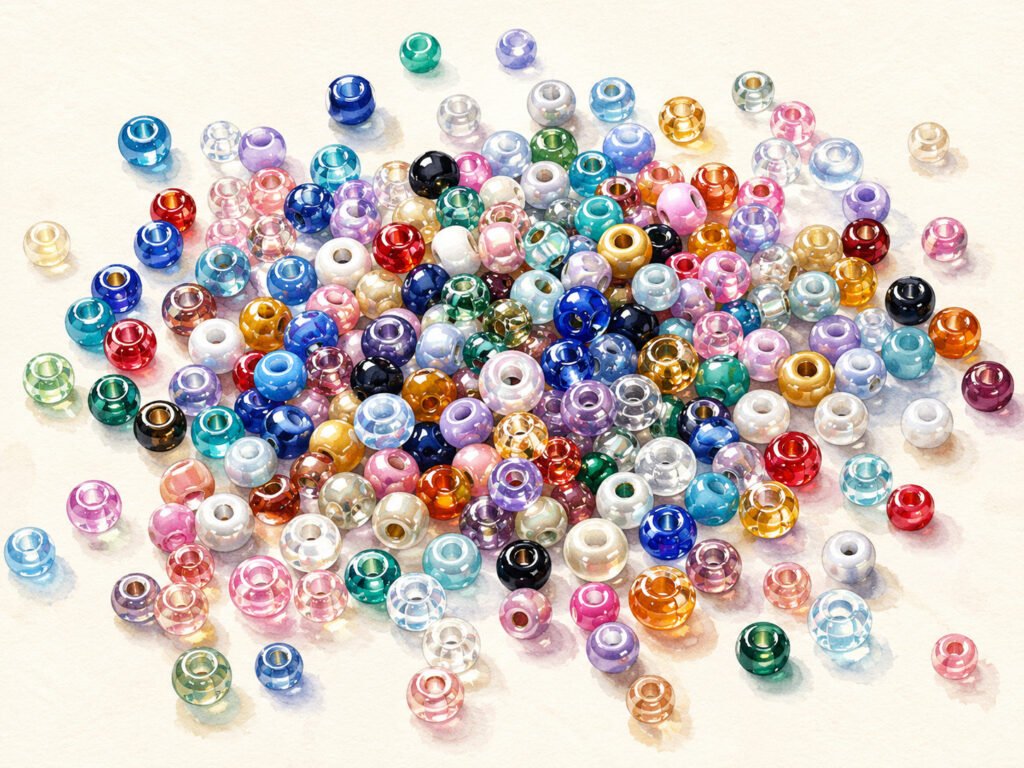
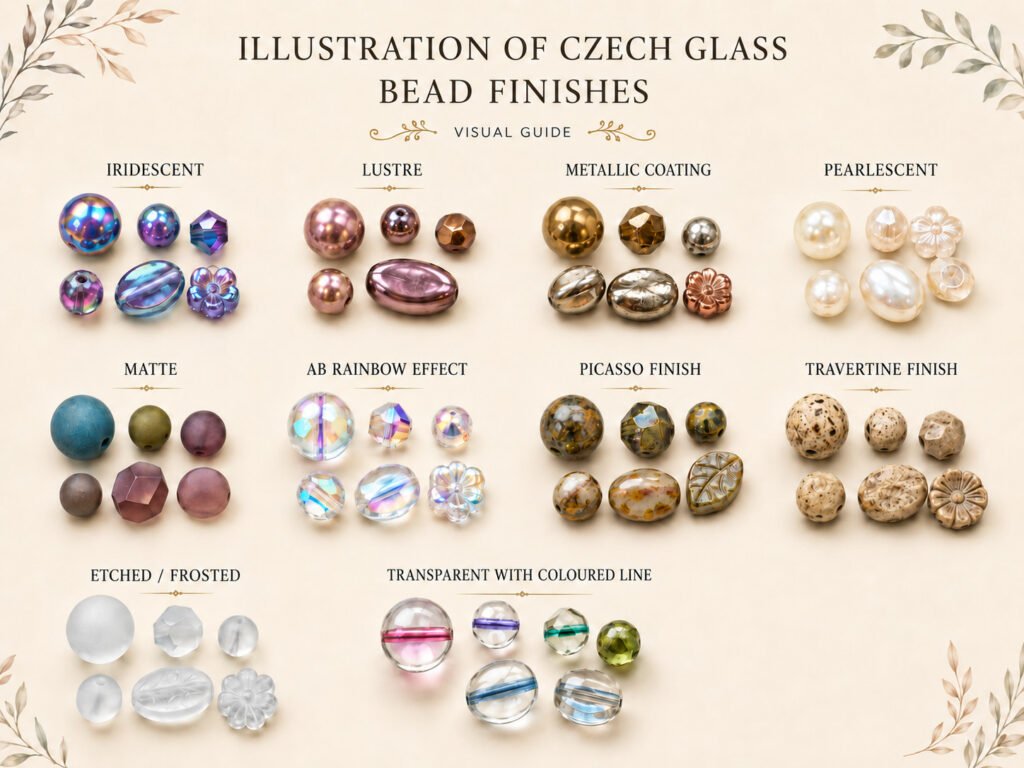
Coatings and finishes — giving glass a second skin
After the main manufacturing stages, beads may receive coatings or surface finishes. The same basic bead can then take on a completely different appearance.
Workshops use a variety of techniques, including dipping, spraying, painting, metallizing, vacuum coating and the application of several successive layers. Some finishes cover the entire bead, while others highlight only raised areas or selected sections. In some cases, a finish is applied before cutting — the grinding process then removes part of it, revealing a contrast with the original glass underneath.
Examples include:
- iridescent finishes, which create shifting reflections;
- lustered finishes, which add a pearly or satin-like sheen;
- metallic coatings in gold, silver, copper, bronze, hematite or chrome tones;
- pearlescent effects, which imitate the soft appearance of mother-of-pearl;
- matte finishes, with a softer, more powdery look;
- AB or rainbow effects, which create multicolored reflections;
- Picasso finishes, marbled or mottled, with an aged or mineral-like appearance;
- travertine finishes, with a more stone-like, speckled or natural effect;
- vitrail effects, with intense, multicolored reflections;
- etched finishes, which give the surface a frosted look, as though it had been sandblasted;
- color-lined finishes, where color is applied inside the bead hole to create greater visual depth.
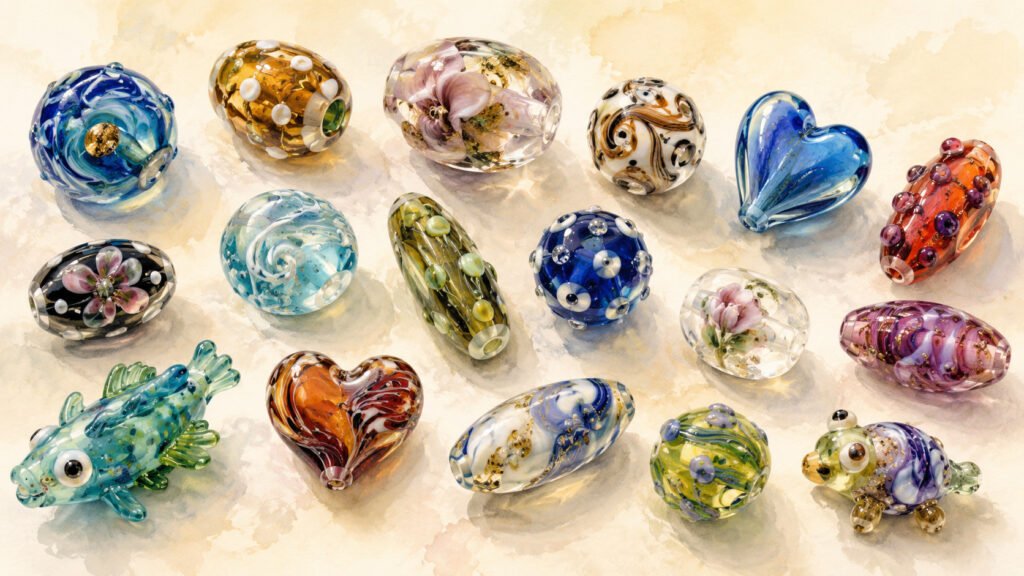
Lampworked beads — small pieces shaped by hand
Among Czech beads, alongside pressed beads, there is another more distinctive family — lampworked, or flame-worked, beads. In English, they are commonly known as lampwork beads.
Despite the name, which can sometimes be translated too literally as “lamp beads”, they have nothing to do with lighting. The word lamp refers to the flame of an oil or alcohol lamp, once used to heat the glass. Today, this work is more commonly carried out with a torch.
Despite their name, which is sometimes translated too literally as “lamp beads”, they are not intended for lighting. The word lamp refers to the flame of an oil or alcohol lamp, once used to heat the glass. Today, this work is more commonly carried out with a torch.
These beads are shaped by hand by winding colored molten glass around a metal rod. This technique gives them a freer, more sculptural character and often makes each one feel more individual. Every bead becomes a small original piece, even when produced as part of a series.
They can also play with color, transparency, texture and decorative effects. Their main distinctive feature, however, lies in the way they are made. They are shaped in the flame rather than pressed into a mold.
These handmade beads can be used in jewelry, ornaments, decorative accessories or more expressive and playful creations. They come in a variety of shapes — round, olive-shaped, cylindrical, heart-shaped or more free-form designs. They are generally pierced so they can be strung or incorporated into a creation.
The main families of Czech beads — a simple guide
To keep things simple, Czech glass beads used in jewelry, embroidery, bead weaving and creative work can be grouped into several main families.
Pressed beads
Pressed beads are shaped directly by the mold. After tumbling, washing, sorting and, where applicable, the addition of a surface finish, they can be used as they are. They may be round, oval, teardrop-shaped, floral, leaf-shaped, heart-shaped or made in a wide variety of other forms.
Fire-polished beads
Fire-polished beads are usually pressed beads that have first been faceted. They are then heated again to restore a smooth, glossy surface. Their appearance recalls cut gemstones, but with a softer play of light than that of sharply faceted crystal.
Table-cut beads
Table-cut beads are pressed beads whose surfaces are ground more broadly and graphically. This technique can reveal color contrasts, create textured effects or give the bead a flatter, more decorative appearance, sometimes resembling a button or ornamental element.
Seed beads
Seed beads are tiny, highly regular beads widely used for bead weaving, bead embroidery, delicate jewelry, fringes, textile patterns and decorative accessories.
Lampworked beads
Lampworked beads form a category of their own. Shaped by hand using a flame, they involve a more manual and free-form process and often have a more expressive character. They are a reminder that not all Bohemian beads are made using the same technique.
It is this succession of techniques — pressing, tumbling, faceting, fire polishing, cutting, coating, washing, sorting and shaping in the flame — that explains the remarkable variety of Bohemian glass beads. From a simple colored glass rod, workshops can create understated round beads, sparkling faceted beads, flat pieces with an aged appearance, tiny seed beads, and metallic, pearlescent, iridescent or matte effects. Each finish becomes a different way of bringing the light to life.
Key points
Pressed beads retain the shape given by the mold.
Faceted beads are ground to catch and reflect the light.
Fire-polished beads regain their shine after being reheated.
Table-cut beads are ground to create flat, decorative surfaces.
Seed beads are mainly used for weaving, embroidery and fine jewelry.
Lampworked beads are shaped by hand in the flame, giving them a freer, more sculptural and often more individual character.
What makes Bohemian beads so distinctive
Les perles en verre de Bohême sont appréciées pour plusieurs raisons.
Bohemian glass beads are valued for several reasons.
For their variety. They come in an extraordinary range of shapes, sizes, colors and finishes. This diversity makes it possible to create very different styles of jewelry — understated, romantic, vintage, bohemian, elegant, precious, playful, graphic or whimsical.
For the way they interact with light. Because they are made of glass, they can play with transparency, depth, reflection, opacity and iridescence. The same color can appear different depending on natural light, the skin, the metal used, the thread, the fabric or the other beads placed alongside it.
A bead does not simply carry a color; it creates a mood. A transparent green can evoke nature, a deep navy blue can bring elegance, amber can add warmth to a design, and clear crystal can create a sense of lightness, while an iridescent finish can sometimes turn a very simple piece of jewelry into a luminous detail.
For their historical roots. These beads did not emerge simply as a modern craft product. They belong to a much older tradition of manufacturing and export, closely linked to costume jewelry and the glassmaking heritage of Central Europe.
And finally, they have a particular charm because they can be both simple and highly refined. A small transparent bead may seem modest on its own, yet become beautiful when paired with brass, waxed cotton, linen, a fine chain or delicate embroidery.
Beads for jewelry — and so much more
When we think of Bohemian beads, jewelry usually comes to mind first — bracelets, necklaces, earrings, brooches, rings and bag charms.
But their uses go far beyond jewelry.
Small seed beads and glass beads can also be used in embroidery, clothing, textile accessories, decorations, ornaments, costumes, traditional objects and contemporary creations.
They can be sewn onto fabrics, incorporated into patterns, or used to add texture and light. A glass bead can transform a surface — drawing the eye, creating a point of sparkle and adding dimension.
That may be one of the reasons for their lasting appeal: they are small, yet highly expressive. They do not necessarily dominate a piece, but they can completely change the way a piece of jewelry or an accessory is perceived.
Why are Bohemian beads still so popular today?
If Bohemian glass beads continue to appeal today, it is because they answer several very contemporary desires.
First, they make it possible to create truly personal jewelry. In a world where many accessories can look alike, beads offer a great deal of freedom — the freedom to choose your colors, create your own rhythm, combine different materials, and design a piece that is either subtle or more expressive.
They also carry a sense of history. Even when produced in larger quantities, they remain connected to a long glassmaking tradition. They give the feeling of working with a material that has a story behind it.
They are traveling objects too. From the workshops and factories of Central Europe, they have made their way to many countries, becoming part of jewelry, embroidery, costumes, accessories and contemporary creations. Their story does not end with their place of origin. It continues in the hands of those who choose them, combine them and give them new meaning.
They are also appealing because they can be very accessible. Glass makes it possible to create luminous effects without using precious stones. It can produce a rich visual impression with a simpler material that is nevertheless highly expressive.
They also fit well with today’s interest in objects that have meaning. We are no longer looking only for something beautiful to wear. We also want to understand where materials come from, how they are made and why they exist.
Bohemian beads speak to that curiosity — they invite us to slow down, look more closely and create with intention.
Conclusion — light in the details
Bohemian glass beads have the particular charm of modest objects that become all the more fascinating when we take the time to understand them.
They can be seen simply as jewelry components. But they can also be viewed as the result of an age-old craft, a region shaped by glassmaking, and a constant exploration of color, form and light.
They show how a small detail can give a creation its personality. Sometimes a single bead is enough to change the character of a piece of jewelry, bring a color to life, evoke a particular era or add a touch of light.
They also remind us that there are many shades between handmade craft and industry. Expertise can be passed down through workshops, but also through larger manufacturers. It can evolve alongside machines, catalogs, designers and exports while still retaining a strong identity.
That is probably why Bohemian beads continue to inspire — because they are at once simple, decorative, accessible and rich in history.
Where to buy Bohemian glass beads?
After discovering their history and craftsmanship, you may feel inspired to take a closer look at these beads, collect them or use them in your own creations. In that case, it is best to turn to established manufacturers, specialist shops or trusted retailers. Terms such as “Czech glass beads”, “Made in Czech Republic”, “Preciosa Ornela”, “Crystal Valley” or “Jablonec nad Nisou” are useful clues when beginning your search.
Here are a few useful addresses and websites where you can discover or buy Czech beads with greater confidence.
Online shops for international customers
Kraftika — Czech glass beads online — worldwide shipping
Explore Czech glass beads at Kraftika
Kraftika offers a wide selection of Czech glass beads, from Preciosa seed beads to pressed, faceted and sculpted beads, in a remarkable variety of shapes and colors. Based in Prague and shipping worldwide, it is a useful destination for exploring the diversity of Czech glassmaking today.
Perles & Co — French bead shop with international delivery
Discover Bohemian glass beads at Perles & Co
Perles & Co is a French specialist retailer offering a wide selection of Bohemian glass beads, including fire-polished and faceted beads in numerous colors, shapes and sizes. Their luminous finishes make them ideal for bracelets, earrings, necklaces and many other beaded creations. Perles & Co ships internationally and is also listed by PRECIOSA ORNELA as an official retail partner in France.
Czech manufacturers, shops and places to discover
PRECIOSA ORNELA — Czech beads and seed beads at the source
Discover PRECIOSA ORNELA and find an authorized retailer
PRECIOSA ORNELA is one of the leading names in Czech glass beads and seed beads. Its official Bead Shop is located at Zásada 317, 468 25 Zásada, Czech Republic, where a selection of products can be purchased directly. For international customers, PRECIOSA ORNELA also provides a worldwide network of authorized distributors, making it possible to find Czech beads and seed beads from a retailer closer to home.
G&B Beads — bead shop, factory and glass bead museum
G&B Beads combines a Czech glass bead manufacturer, an online shop and a museum devoted to beadmaking. Its museum and factory tours explore both historical and modern production techniques, including pressing, tumbling, cutting and stringing. It is a particularly interesting destination for discovering Czech beads directly from a manufacturer, whether online or during a visit to Jablonec nad Nisou.
G&B Beads — Janovská 132/39 — 466 04 Jablonec nad Nisou — Czech Republic
Factory shop — Janovská 39 — 466 01 Jablonec nad Nisou — Czech Republic
CZECH BEADS s.r.o. — Czech glass bead manufacturer in Jablonec nad Nisou
Shop Czech glass beads directly from CZECH BEADS
CZECH BEADS s.r.o. is a small family-run manufacturer and seller of original Czech glass beads based in Jablonec nad Nisou – Kokonín. The company produces a wide range of pressed, fire-polished and table-cut beads, including distinctive shapes, colors and surface finishes. It is an interesting address for discovering Czech glass beads directly from the people who design and manufacture them.
CZECH BEADS s.r.o. — Maršovická 181 — Jablonec nad Nisou – Kokonín — 468 01 — Czech Republic
JABLONEX – The Czech Beads — specialist in Bohemian glass beads
JABLONEX specializes in Bohemian glass products, with pressed glass beads at the heart of its range. The online shop also offers fire-polished, faceted, table-cut and seed beads in a wide variety of shapes and finishes. With international delivery available to many countries, it is a useful source for discovering and buying Czech glass beads directly from a company rooted in the region’s long glassmaking tradition.
JABLONEX s. r. o. — Průmyslová 907 — 468 22 Železný Brod — Czech Republic
Note on the illustrations: the visuals in this article are atmospheric illustrations intended to accompany the explanations. They are inspired by the world of Czech glass beads and are not documentary photographs of specific beads, workshops or manufacturing sites.
Sources and further reading
To write this article, I drew on a range of resources about Bohemia, Crystal Valley, Czech glass, Bohemian glass beads, the Jablonec nad Nisou region and traditional glassmaking expertise.
- Opening quotation — Maxim Velčovský / Gaggenau Magazine
Source of the original quotation on Bohemian glass. - Wikipedia — Bohemia
For background on Bohemia as a historic region of Central Europe. - Crystal Valley — Northern Bohemia’s glassmaking region
For background on the glassmaking heritage of northern Bohemia.. - Visit Czechia — Bohemian glass
For information on the Czech glassmaking tradition, glass beads and Jablonec nad Nisou. - Museum of Glass and jewelry in Jablonec nad Nisou — The Endless Story of jewelry.
For information on the history of costume jewelry, beads, seed beads and decorative ornaments in Jablonec nad Nisou. - G&B Beads / Beadmaking Museum
For a concrete example of a Czech company and museum devoted to the production of glass beads. - Preciosa Ornela — Czech glass beads and seed beads
For information on Czech beads and seed beads, their production, shapes, colors and fire-polished finishes.
About the company — Fire-polished beads - UNESCO — Knowledge, craft and skills of handmade glass production
For the inscription recognizing the knowledge, techniques and skills associated with traditional handmade glass production. - UNESCO — Handmade production of Christmas tree decorations from blown glass beads.
For the Czech tradition of making Christmas tree decorations from blown glass beads.