
« Style is something each of us already has, all we need to do is find it. »
— Diane von Furstenberg
☆
Have you ever put on an outfit and thought, “This really feels like me”?
It is often in these simple moments that your personal style begins to reveal itself. A color that brightens your complexion, a fabric that feels comfortable to wear, a cut that lets you move with ease, a detail that gives you confidence…confiance…
Style is not just about clothes. It also says something about the woman you are, the woman you want to be, and sometimes even the woman you are becoming.
Yet it is not always easy to know what truly suits us, what brings out our best features, what makes us look our best or, on the contrary, what seems to wash us out a little. Some pieces catch our eye on the hanger but somehow do not feel like us once we put them on. Others, chosen almost instinctively, seem to match our mood perfectly.
Whether you already have a clear sense of what you like or are still exploring, these 10 tips will help you refine your style, understand your wardrobe better, and create outfits in which you can truly feel like yourself.
1. Don’t Confuse Fashion with Style
Finding your personal style doesn’t mean following every trend.
Fashion is always changing. It belongs to a particular time, society, and collective imagination. It brings us colors, cuts, fabrics, lengths, and prints. And it follows the seasons, the runways, shop windows, and the mood of the moment. Fashion can be joyful, inspiring, and creative, but it can also become exhausting when it makes us feel as though we should constantly be updating our wardrobe.
Style, on the other hand, is more intimate and more personal. It doesn’t depend solely on what is fashionable. It grows from what we enjoy wearing, what makes us feel comfortable, what makes us feel truly ourselves, and what reflects our personality.
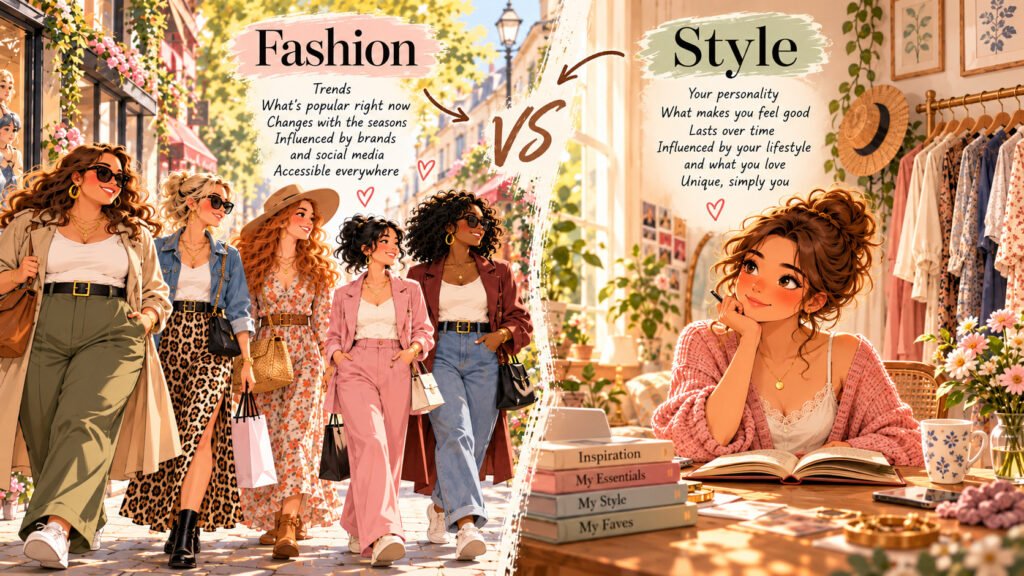
A woman can enjoy trends without following them blindly. You can borrow a color, a cut, or an accessory from fashion and adapt it to make it your own. A trend becomes interesting when it connects with something in you — a desire, a mood, a silhouette, or a color that makes you glow.
The aim is not to reject fashion, but to put it in its proper place. It can inspire you, but it shouldn’t decide for you.
A personal wardrobe begins to take shape when you learn to tell the difference between:
- what catches your eye because you have seen it everywhere;
- what you genuinely like;
- what you will actually wear;
- what makes you feel confident.
Style often begins right there — in your ability to choose, to filter, and to listen to what truly feels right for you.
2. Take Stock of Your Wardrobe
Before looking for new clothes, it can be helpful to take a closer look at what you already own. Your wardrobe already says a lot about you — your preferences, your habits, what you’re naturally drawn to, but also the pieces you keep without ever really wearing them. Take a moment to look through your clothes.
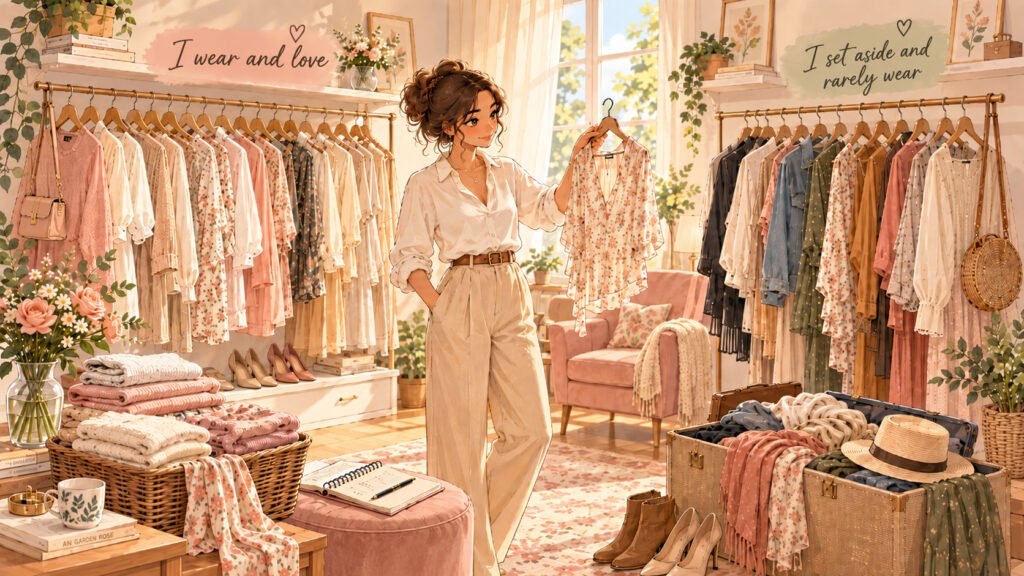
To get a clearer picture, start by making two piles.
In the first, gather the clothes, shoes, and accessories you genuinely love. The ones you wear often, feel good in, and reach for naturally, without hesitation. These are often the pieces that offer the clearest clues to your natural style.
In the second pile, place the pieces you never wear, or hardly ever. The ones that stay at the back of your closet, that may have appealed to you when you bought them, but that you never reach for in everyday life. The ones that are too tight, too loose, too bold, too dull, too delicate, too difficult to style, or simply too far removed from who you are.
Then look at what each pile reveals.
Among the pieces you love, which colors appear most often? Do you tend to prefer soft tones, natural shades, bright colors, or deeper hues?
Look at the fabrics too. Do you tend to prefer natural or synthetic fabrics? Are there certain fabrics that make you feel more at ease, more comfortable, or perhaps more elegant?
Next, look at the shapes and cuts. Do you prefer loose or fitted clothes? Defined waists or straighter silhouettes?
Then do the same exercise with the clothes you never wear. You may notice that a certain color makes you feel uncomfortable, that a particular cut doesn’t suit your silhouette, that you love a print on the hanger but not once you put it on, or that a fabric becomes uncomfortable as the day goes on.
The aim of this exercise is not to judge your wardrobe. It is simply a way to better understand what truly feels like you. It can help you identify impulse purchases, pieces you keep “just in case,” and the ones that already form the foundation of your personal style.
3. Discover the Colors That Suit You Best
Colors have an incredible power. They can brighten your face, soften your overall look, bring a simple outfit to life, or create a sense of calm and harmony.
Finding your style often means discovering your own color palette. This doesn’t necessarily mean following a strict color analysis method, but rather paying attention to the colors you love, the ones that brighten your complexion, and the ones you enjoy wearing again and again.
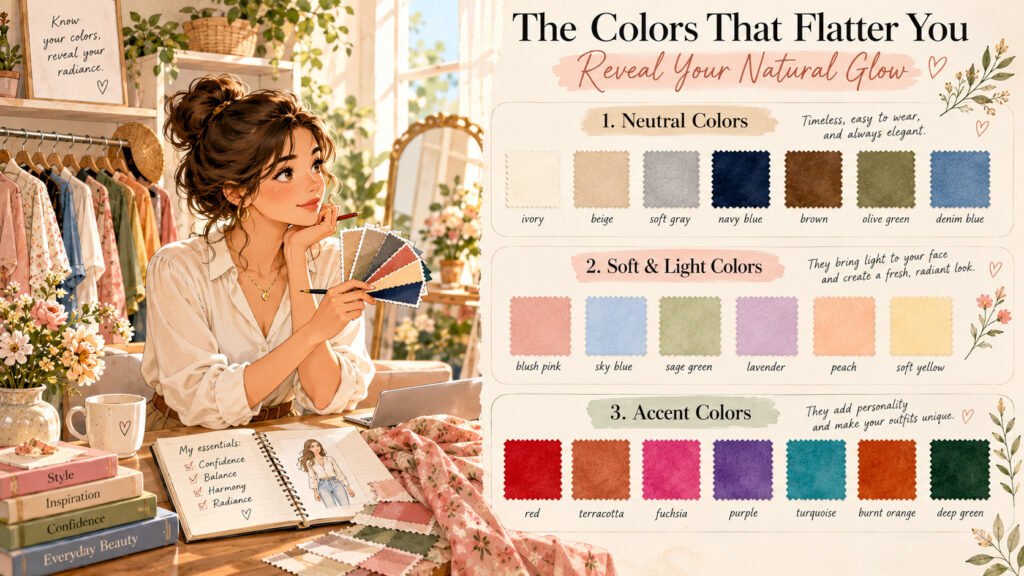
You can start with three color families.
Foundation colors are the ones that form the backbone of your wardrobe. They are easy to mix and match and can appear again and again: ecru, beige, off-white, gray, black, navy, brown, khaki, and denim.
Light-enhancing colors bring softness or brightness: dusty pink, sky blue, sage green, lilac, soft coral, pale yellow, peach, cream, and subtle gold.
Finally, accent colors add character to an outfit: red, fuchsia, purple, burnt orange, deep green, turquoise, floral prints, and graphic patterns.
A harmonious wardrobe doesn’t have to be monotonous. It can combine neutral tones with a few more personal touches.
To discover your own colors, take inspiration from the surroundings you naturally love as well. Some people are drawn to seaside shades — soft blue, sand, white, and pearl gray. Others prefer autumn colors — rust, brown, khaki, mustard, and burgundy. Others feel more at home in delicate shades such as dusty rose, cream, lavender, and almond green.
Your color palette can become a kind of personal landscape. It brings a sense of cohesion to your wardrobe, makes pieces easier to combine, and encourages more thoughtful purchases.
Before buying something in an unusual color, ask yourself one simple question: Is this a color I only enjoy looking at, or one I genuinely enjoy wearing?
4. Choose Fabrics You Truly Enjoy Wearing
Style isn’t only something you see — it’s something you feel.
A fabric can completely change the way you experience a garment. A linen dress, a cotton blouse, a knitted cardigan, a velvet jacket, or a flowing skirt will each feel different and create a different look. Some fabrics move with the body, while others give structure to the silhouette. Some keep you warm, others allow the skin to breathe, and others add a touch of elegance or delicacy.
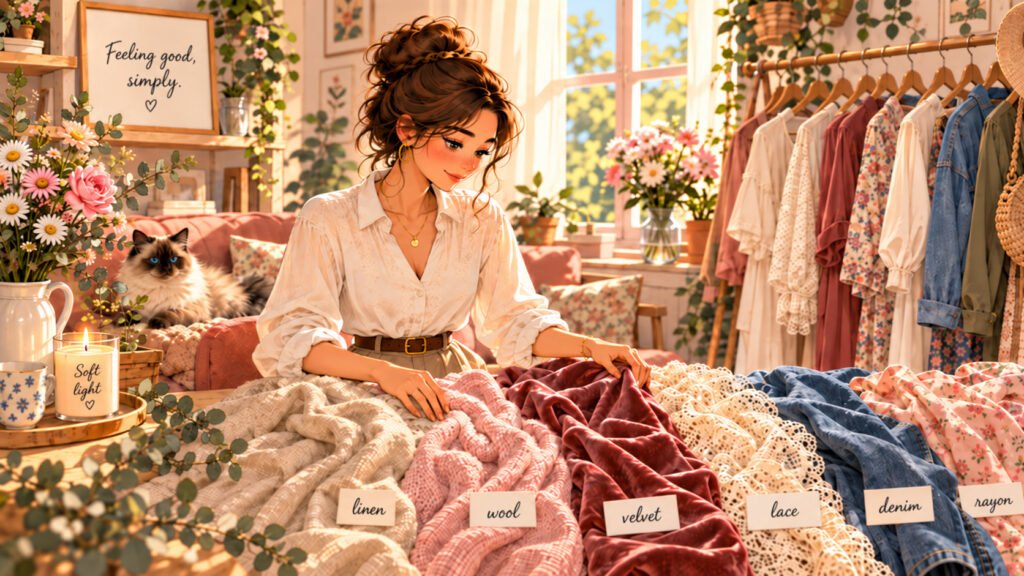
Textile fibers each have their own qualities and environmental trade-offs. Cotton is soft and easy to care for, but growing it can require significant amounts of water. Linen and hemp often require less water. Wool provides warmth, while viscose has a smooth, silky feel but requires chemical processing. Synthetic fibers can also release microplastics during production, use, and washing.
Rather than striving for perfection, it can simply be helpful to choose fabrics a little more thoughtfully.
Ask yourself what you genuinely enjoy wearing:
- natural, breathable fabrics;
- flowing fabrics that move with you;
- soft, cozy knits;
- structured cottons;
- naturally crinkled fabrics such as linen;
- textured fabrics such as embroidery, velvet, cotton gauze, or crochet;
- smoother, more elegant fabrics.
The same color can tell a very different story depending on the fabric. A black cotton dress may feel simple and easy to wear, while in velvet it can appear richer and more dramatic. In satin, it may feel more dressed-up; in linen, more natural; and in lace, more romantic.
Fabrics are therefore an essential part of personal style. They reflect the way you relate to comfort, femininity, simplicity, movement, and touch.
5. Understand the Balance of a Silhouette
A successful outfit is not just about the individual pieces you choose. It also depends on the overall balance of the silhouette.
But that does not mean following strict rules or trying to “correct” your body. The idea is to learn how to work with shapes, volume, and proportions to create a look in which you feel comfortable and confident.
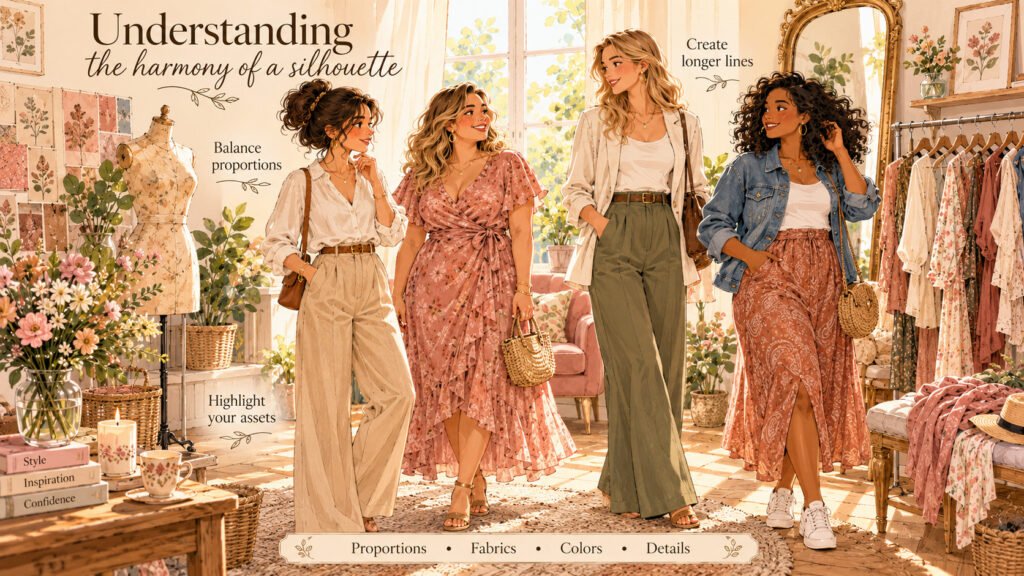
A silhouette can also be built around contrasts:
- loose on top, more fitted on the bottom;
- flowing on the bottom, more structured on top;
- long and short;
- simple and more detailed;
- relaxed and waist-defining;
- neutral and colorful.
For example, a flowing blouse can work beautifully with straight-leg pants. A long skirt can be balanced with a cropped jacket. A loose-fitting dress can be defined with a slim belt. A simple pair of jeans can look more polished with a bright shirt and a well-cut jacket.
The Palais Galliera, the Fashion Museum of the City of Paris, shows through its haute couture collections how silhouettes have evolved over time, shaped by designers, volumes, lines, and fabrics. It is a reminder that a silhouette is never simply a collection of clothes — it is a visual composition.
To find the balance that feels right for you, experiment in front of a mirror without putting any pressure on yourself. Tuck a blouse into your pants, then wear it untucked. Add a belt, then take it off. Try a cropped jacket, then a long cardigan. Change your shoes. Tie on a scarf. You’ll quickly see what you like best.
Style also takes shape through these small adjustments.
6. Choose Cohesion Over Accumulation
Having more clothes doesn’t necessarily mean having more style. Sometimes, the opposite is true: the fuller your closet becomes, the harder it can be to choose what to wear.
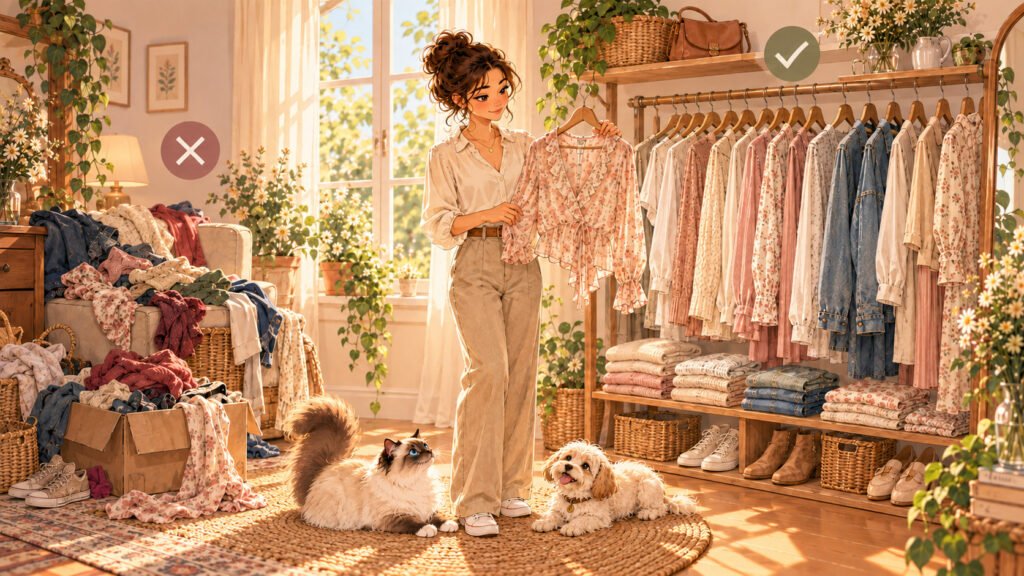
A wardrobe that feels like you doesn’t need to be huge. What matters most is that it feels cohesive. Your clothes should work well together, be easy to mix and match, suit your everyday life, and reflect your personality.
In many ways, this is close to the idea of a capsule wardrobe, without necessarily imposing a strict number of pieces. The goal here is not to live with just ten items or follow a rigid method. It is simply about choosing clothes that are useful, well loved, and easy to combine.
A woman who works from home or enjoys walks and creative activities will not have the same needs as someone who dresses more formally every day. A successful wardrobe is not an idealized wardrobe seen in a magazine — it is one that fits your real life.
So before buying something new, ask yourself a few simple questions:
- Does this piece work with what I already own?
- Can I imagine wearing it in at least three different outfits?
- Do I genuinely love it, or do I only like it because it is on trend?
- Will I actually wear it in my everyday life?
- Does it suit my comfort and my style?
Buying less, but choosing more carefully, can often help you build a more personal wardrobe.
7. Use Accessories as Your Signature
Accessories are wonderful allies when it comes to expressing your personal style, because they can transform a simple outfit without changing everything.
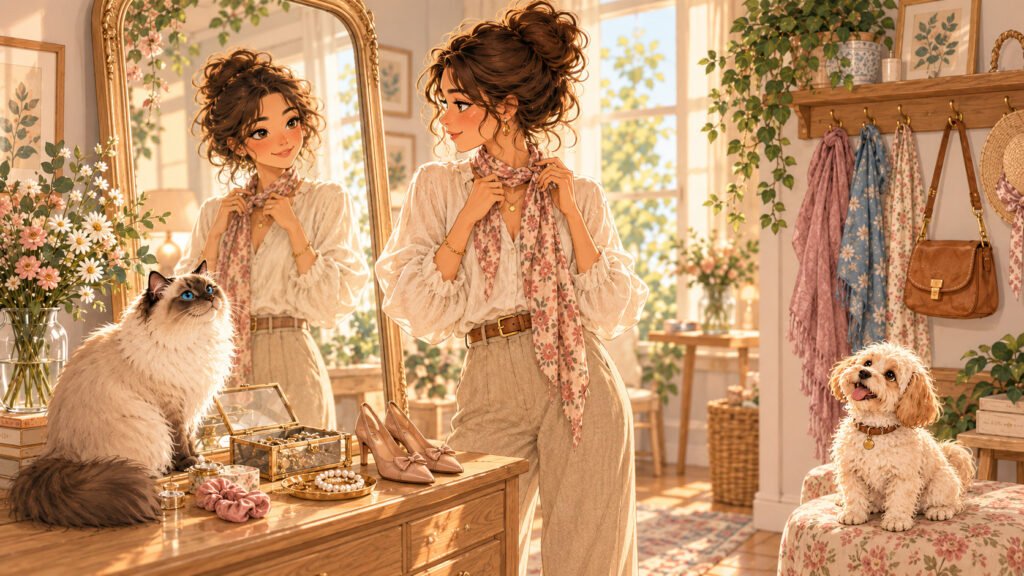
A scarf, a belt, a bag, a pair of earrings, a necklace, a brooch, a hair clip, a watch, a hat, or a pair of shoes can completely change the direction of an outfit.
A plain dress can become more romantic with a delicate necklace and a floral scarf. A pair of jeans and a white T-shirt can feel more polished with a jacket, a belt, and gold jewelry. And a simple sweater can gain personality with a vintage brooch or a colorful scarf.
Accessories are also a gentle way to be a little more daring. For example, if you are unsure about wearing a bright color, start with a scarf. If you love prints but do not feel ready to wear them as a dress, try them on a bag, a headband, or a scarf instead. And if you are drawn to a bohemian, romantic, or whimsical style, jewelry and accessories let you bring it into your look through small touches.
This is often where your personal signature begins to emerge. Some women love delicate jewelry, while others prefer bolder pieces. Some almost always wear a scarf; others are drawn to distinctive bags, colorful shoes, hair accessories, brooches, natural textures, or touches of gold.
An accessory can become a recurring thread throughout your wardrobe, connecting different outfits and giving your style a recognizable personal touch.
8. Find Inspiration Without Comparing Yourself
Inspiration is valuable. It sharpens your eye, opens up new possibilities, and makes you want to experiment with new combinations. But it can become discouraging when it turns into comparison.
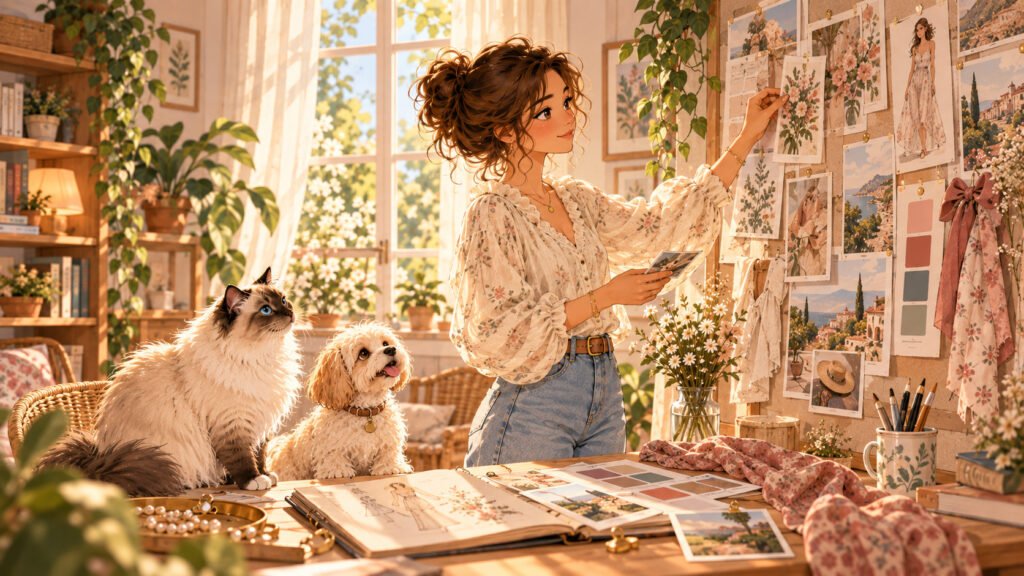
Social media, magazines, shop windows, films, museums, paintings, old photographs, nature, travel, and everyday objects can all inspire your style.
But the goal is not to copy a perfect look. It is to notice what genuinely draws you in.
You can start by creating an inspiration journal, on paper or digitally, and collect:
- colors;
- outfits;
- fabrics and textures;
- jewelry;
- hairstyles;
- details such as sleeves, collars, buttons, and belts;
- moods and atmospheres;
- words.
Next, look for the things that keep coming back. You may notice that you are repeatedly drawn to natural tones, flowing dresses, cropped jackets, wicker bags, floral prints, embroidered blouses, gold jewelry, or comfortable shoes.
These recurring elements matter. Together, they form a kind of personal map of your style.
Finding inspiration without comparing yourself means looking at others not to feel inadequate, but to better recognize what resonates with you.
9. Adapt Your Style to the Seasons Without Losing Yourself
Your style can evolve with the seasons without disappearing. In fact, the seasons can help you refresh your outfits while still keeping a consistent thread running through your wardrobe.
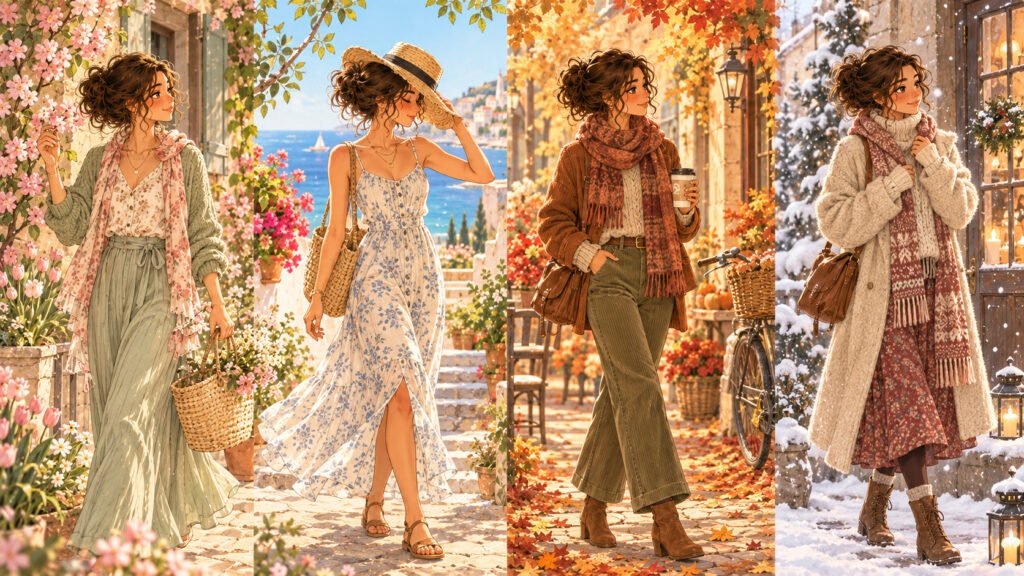
In spring, you may find yourself drawn to fresher colors, lightweight blouses, relaxed jackets, floral scarves, woven baskets, or lighter-colored shoes.
In summer, breathable fabrics and flowing cuts often take center stage: lightweight dresses, long skirts, linen, cotton, sandals, hats, and bags made from natural materials.
In autumn, the palette often becomes warmer and richer: terracotta, brown, burgundy, khaki, warm beige, ochre, and navy. Knits, jackets, ankle boots, and scarves gradually return.
In winter, style often comes through layering: coats, scarves, sweaters, dresses with tights, boots, cozy fabrics, and warm accessories.
The idea is not to rebuild your entire wardrobe four times a year. It is simply about adapting your fabrics, colors, and combinations.
And if your style is feminine and understated, it can take the form of a floral blouse in spring, a flowing dress in summer, a cozy cardigan in autumn, and a scarf with layered textures in winter.
The seasons refresh your style — they don’t erase it.
10. Accept That Your Style Evolves With You
Finding your style doesn’t mean finding one fixed formula for life. Your style can change over time — with your age, your preferences, your body, your everyday life, your work, the different seasons of your life, or even your confidence.
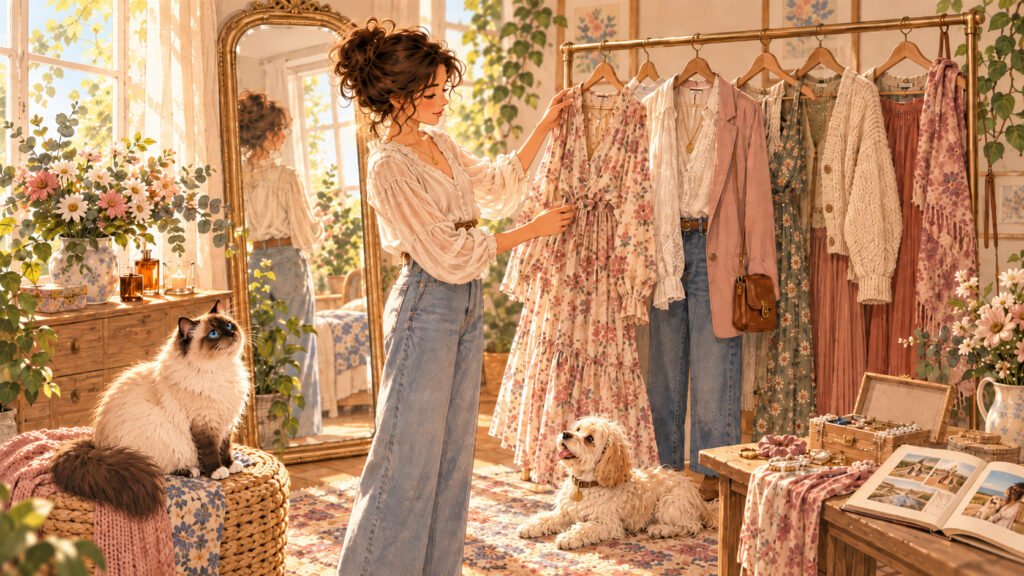
It is perfectly normal to stop loving certain pieces you once wore all the time. It is also natural to want more simplicity, more color, more comfort, more elegance, or a softer feel at different stages of life.
Personal style is not fixed — it is alive.
Accepting that evolution can help you let go of guilt. A wardrobe does not need to be perfect. It can hold experiments, memories, pieces you keep for a little while longer, clothes you alter, donate, resell, or repair.
Letting your style evolve doesn’t necessarily mean throwing everything away and starting over. It can simply mean:
- wearing a forgotten piece in a new way;
- shortening a dress;
- changing the buttons on a jacket;
- repurposing a scarf;
- having a zipper repaired;
- donating a piece that no longer feels like you;
- keeping only what reflects who you are today.
Your style doesn’t need to be perfect to be beautiful — above all, it needs to feel authentic.
A Simple Exercise — Create Your Style Journal in 7 Days
To ease into it, here is a simple exercise you can try over the course of a week.
Day 1: Choose Your Favorite Pieces
Take out five clothes or accessories you genuinely love. Write down why you love them: the color, fabric, cut, comfort, a memory attached to them, compliments you have received, or simply how easy they are to wear.
Day 2: Look at the Pieces You Never Wear
Look at them without judging yourself. Ask yourself what is holding you back: the color, fit, fabric, cut, occasion, care requirements, or comfort?
Day 3: Identify Your Colors
Write down the colors that appear most often among your favorite clothes. They may form the foundation of your personal color palette.
Day 4: Pay Attention to Fabrics
Touch your clothes. Which ones do you genuinely enjoy wearing? Which ones irritate your skin, feel too tight, make you too warm, or simply don’t fall the way you would like?
Day 5: Put Together Three Outfits with What You Already Own
Try new combinations. Add a belt, a scarf, a jacket, or some jewelry. If you create an outfit you like, take a photo of it.
Day 6: Choose Your Style Keywords
Write down five words that describe the style you would like to cultivate. For example: soft, natural, radiant, feminine, creative, elegant, comfortable, romantic, simple, confident.
Day 7: Identify What You’re Really Missing
Make a short list of useful pieces. Not an impulse-shopping list, but a list of what could genuinely complete your wardrobe.
Explore Courses to Better Understand Your Style
Finding your style is a personal journey that develops over time, through experimentation and a better understanding of yourself. If you would like to go further, online courses can help you explore some of the topics covered in this article in greater depth — learning how to put together harmonious outfits, understanding colors and fabrics more clearly, discovering the principles of color analysis, or getting an introduction to image consulting techniques. Here are three courses with complementary approaches that you can take online and at your own pace.
Fashion Styling: Design Your Looks — Domestika
This online course offers a creative and accessible approach to learning how to put together looks that feel like you. You’ll explore wardrobe basics, cuts, patterns, textures, and colors, along with different ways to combine them to create balanced, personal outfits.
It is a natural extension of the ideas explored in this article if you would like to train your eye, experiment more, and feel more confident putting outfits together. The course is entirely online, self-paced, and English audio is available
Discover the “Fashion Styling: Design Your Looks” course on Domestika
Learn Fashion Styling | Dress like a Fashion Icon — Udemy
This online course offers a practical approach to developing your personal style and making more confident wardrobe choices. It explores different style personalities, body proportions, color analysis, and the principles that can help you choose clothes that suit both your preferences and your everyday life.
It is a useful complement to the ideas explored in this article if you would like to go a little further, better understand the colors and silhouettes that work for you, and build a wardrobe that feels more intentional and personal. The course is available online, in English, and can be followed at your own pace.
Discover the “Learn Fashion Styling | Dress like a Fashion Icon” course on Udemy
Personal Shopper and Stylist Business – Centre of Excellence
If you would like to explore the subject in greater depth, this online course looks at personal style, color, body shape, wardrobe planning, personal shopping, and personal styling.
It covers how to analyze a wardrobe, create selections suited to different body shapes and lifestyles, and build a more cohesive wardrobe. The course also goes further by introducing client relationships and the possibility of developing a professional activity as a personal stylist or personal shopper.
The course is fully online and self-paced. It is taught in English.
Discover the “Personal Shopper and Stylist Business” course from Centre of Excellence
Conclusion
Finding your style is both a simple and deeply personal journey. It is not about following every trend or owning a large number of clothes. It is about getting to know yourself better.
The colors you love, the fabrics that make you feel comfortable, the cuts you feel at ease in, the accessories that make you smile, and the silhouettes that give you confidence — little by little, all of these elements come together to create a wardrobe that feels more personal.
Fashion can be a wonderful source of inspiration, as long as it does not become something you feel pressured to follow. Style, on the other hand, develops over time. It becomes more refined, evolves, and moves with the seasons and the different stages of life.
Creating a wardrobe that feels like you is not about trying to become someone else. On the contrary, it is about gently coming back to yourself, making more thoughtful choices, and allowing your clothes to express part of your personality.
A successful outfit is not just a beautiful outfit — it is one in which you feel present, free, and fully yourself.
Sources and Further Reading
If you would like to explore personal style, fashion history, and the relationship between clothing, identity, and the body in greater depth, these museum and research resources offer thoughtful perspectives to complement this article.
- A Life Through Clothes: Professor Lalage Bown, OBE — Victoria and Albert Museum
Clothing can reveal far more than changing trends. Through the wardrobe of Professor Lalage Bown, the Victoria and Albert Museum explores how clothes can reflect personal taste, life experiences, cultural influences, and a particular moment in history. This resource offers an interesting perspective on the idea that a wardrobe gradually becomes part of a person’s story. - Dress, Dreams, and Desire: Fashion and Psychoanalysis — The Museum at FIT
For a deeper look at the connection between fashion, self-image, identity, and desire, this resource from The Museum at FIT approaches clothing through the lens of psychology and fashion history. It explores how dress can influence the way we see ourselves and how we present ourselves to others, making it an interesting complement to the more practical advice in this article. - What Makes CHANEL So Iconic? — Victoria and Albert Museum
Personal style often becomes recognizable through recurring choices — a silhouette, a fabric, a color, an accessory, or a particular way of combining pieces. This V&A article looks at how Gabrielle Chanel developed a distinctive visual language over time through consistency, refinement, comfort, simplicity, and recognizable signature pieces. It offers a fascinating example of how a coherent style can evolve without losing its identity. - Fashion on the Move — Palais Galliera
The Palais Galliera, the Fashion Museum of the City of Paris, offers an online exploration of fashion from the eighteenth century to the present day through the theme of the body in movement. It provides useful historical context for understanding how silhouettes, clothing, and everyday ways of dressing have changed as lifestyles and ideas about movement have evolved.